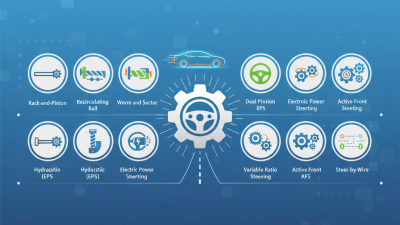
| Rack-and-Pinion Steering Gear |
A pinion gear rotates against a straight toothed rack, converting steering-wheel rotation into side-to-side movement of the steering linkage. |
Most modern passenger cars, crossovers, compact sport-utility vehicles, and many light commercial vehicles. |
Compact design, relatively low weight, direct steering response, fewer moving parts, and good packaging efficiency. |
Less suitable for very high steering loads; damage to the rack, pinion, seals, or inner tie-rod joints can require complete unit replacement. |
Hydraulic power steering, electro-hydraulic power steering, and electric power-assisted rack systems. |
Inspect for fluid leakage, torn bellows, uneven steering effort, looseness, corrosion, and abnormal knocking sounds. |
Choose the exact steering ratio, mounting pattern, input-shaft design, travel length, sensor configuration, and power-assistance type. |
| Recirculating-Ball Steering Gear |
A worm shaft moves a ball nut through recirculating steel balls; the nut turns a sector shaft connected to the steering linkage. |
Pickup trucks, heavy-duty sport-utility vehicles, buses, commercial vehicles, and off-road platforms. |
High load capacity, strong durability, good impact resistance, and suitability for large tires and solid front axles. |
Heavier and less compact than rack-and-pinion systems; may provide less precise on-center feel when worn. |
Commonly paired with hydraulic power assistance; some newer commercial systems use electronically controlled hydraulic assistance. |
Check sector-shaft play, fluid condition, seal leakage, mounting bolts, pitman-arm connection, and steering-wheel free play. |
Prioritize correct vehicle load rating, steering ratio, sector-shaft spline, mounting position, and compatibility with the existing pump and hoses. |
| Worm-and-Roller Steering Gear |
A worm shaft engages a roller mounted on a cross shaft, transmitting steering motion to the linkage. |
Older passenger vehicles, classic cars, light trucks, and selected commercial vehicle applications. |
Can handle moderate steering loads and offers a durable mechanical design when correctly lubricated and adjusted. |
Lower efficiency and less precise steering feel than many modern systems; replacement parts may be less readily available. |
May be used with manual steering or adapted hydraulic assistance, depending on the vehicle design. |
Requires inspection of lubricant, roller wear, shaft seals, adjustment settings, and excessive steering-wheel play. |
Verify the original steering geometry, housing dimensions, shaft orientation, lubricant specification, and availability of service components. |
| Worm-and-Sector Steering Gear |
A worm shaft engages a toothed sector shaft that transfers rotational movement to the steering linkage. |
Early passenger cars, vintage vehicles, agricultural equipment, and certain low-speed utility applications. |
Simple construction, strong mechanical leverage, and suitability for restoration or low-speed heavy-duty use. |
Higher friction, greater backlash when worn, slower response, and limited suitability for modern high-speed vehicle dynamics. |
Usually manual; hydraulic assistance is uncommon and normally requires substantial system-specific engineering. |
Inspect gear-mesh adjustment, lubrication, shaft bushings, seal condition, and steering free play throughout the travel range. |
Buy only when the original vehicle specification requires this design; confirm dimensions and restoration-part availability before ordering. |
| Electric Power Steering Rack |
An electric motor applies assist torque directly to a rack, column, or pinion according to signals from torque and position sensors. |
Modern passenger cars, electric vehicles, hybrid vehicles, compact crossovers, and vehicles equipped with driver-assistance functions. |
No hydraulic fluid, improved fuel or energy efficiency, variable assistance, simplified engine-bay packaging, and easier integration with electronic controls. |
Higher electronic complexity; sensor, motor, software, wiring, or calibration faults may require diagnostic equipment. |
Integrated electric assistance; it is not designed to operate with a conventional hydraulic pump and hose circuit. |
Check diagnostic fault codes, steering-angle calibration, connector condition, motor operation, rack seals, and battery-voltage stability. |
Confirm software and sensor compatibility, required calibration procedures, vehicle network compatibility, and post-installation alignment requirements. |
| Hydraulic Power Steering Gear |
Hydraulic pressure from a pump assists the mechanical steering gear when the driver turns the steering wheel. |
Older passenger vehicles, trucks, buses, off-road vehicles, and applications requiring high continuous steering assistance. |
Strong assistance, established service procedures, predictable operation, and good suitability for high steering loads. |
Pump noise, fluid leakage, parasitic engine load, hose maintenance, and greater environmental sensitivity than electric systems. |
Requires a compatible pump, reservoir, pressure and return hoses, fluid specification, and correctly sized relief-pressure settings. |
Flush or replace fluid as specified, inspect hoses and seals, check belt tension, and test for steering effort changes or pump noise. |
Match hydraulic pressure and flow requirements, port locations, steering ratio, mounting points, and fluid compatibility. |
| Electro-Hydraulic Steering Gear |
An electric motor drives the hydraulic pump, allowing steering assistance to operate independently of engine speed. |
Some hybrid vehicles, compact vehicles with limited engine-bay space, and applications requiring hydraulic steering feel with electronic control. |
Provides hydraulic steering force without a belt-driven pump and can reduce unnecessary pump operation. |
Combines hydraulic and electronic failure points; sensitive to electrical supply, fluid condition, and control-module faults. |
Uses an electric motor-driven hydraulic pump with a compatible hydraulic steering gear or rack. |
Inspect hydraulic leaks, electrical connectors, pump current draw, battery voltage, fluid cleanliness, and control-system fault codes. |
Verify voltage rating, hydraulic pressure and flow, communication requirements, hose connections, and required electronic bleeding or calibration procedures. |